La brecha de resiliencia energética que se abre entre las auditorías
An energy organisation completes its annual security assessment. Policies are current. Important controls are operating. The penetration test has been closed out. Critical suppliers have returned their questionnaires. Recovery plans have been reviewed. The board receives a broadly positive report.
Then the environment starts to change. A software release alters how an operational platform exchanges data with a cloud service. A supplier updates its remote-support model. A privileged account is added to support a transformation programme. An identity platform is reconfigured. Firmware changes on a connected asset. A recovery procedure still refers to an earlier architecture.
None of these events necessarily represents a control failure. None may immediately create an incident. But each changes the evidence on which the organisation’s previous confidence was based.
For an energy organisation, that matters because the service being protected rarely sits inside one system or one department. Generation, network operation, balancing, metering, customer service, market settlement and field operations increasingly depend on operational technology, enterprise IT, cloud services, software, identity, communications, data and third parties working together.
The service may continue to operate while confidence in its resilience quietly weakens. A green dashboard may therefore say more about the controls being monitored than about the complete energy outcome leadership is trying to protect.
The strategic question is no longer whether measures were effective when they were last reviewed. It is what evidence shows that the service remains resilient today.
Mature organisations can still have an evidence problem
The challenge for established utilities is rarely a complete absence of cyber activity. It is whether activity across multiple functions adds up to one current and defensible view of the essential service.
Most large energy organisations are not beginning their cyber-resilience journey. They already have security teams, governance forums, security operations, operational processes, risk registers, incident plans, supplier-risk programmes and established technology controls.
The CISO may have confidence in the control environment. The CIO may have confidence in the architecture, identity and cloud platform. The CTO may have confidence in the software-delivery process. The COO may have confidence in operational workarounds and continuity arrangements. Procurement may have confidence in supplier due diligence. Internal audit may have confidence that expected processes are being followed.
Each view may be reasonable. But the board ultimately owns a different question: can the essential service continue safely, and can it recover within an acceptable boundary, when several dependencies are disrupted at once?
That question crosses organisational ownership. It also exposes the limitation of point-in-time assurance. An assessment can examine the environment presented to it. It cannot preserve confidence indefinitely after the software, suppliers, architecture, access model or recovery arrangements change.
For mature organisations, the next improvement is not necessarily another governance layer or a larger control catalogue. It is a stronger connection between change, operational consequence and refreshed evidence.
What this means for the leadership team
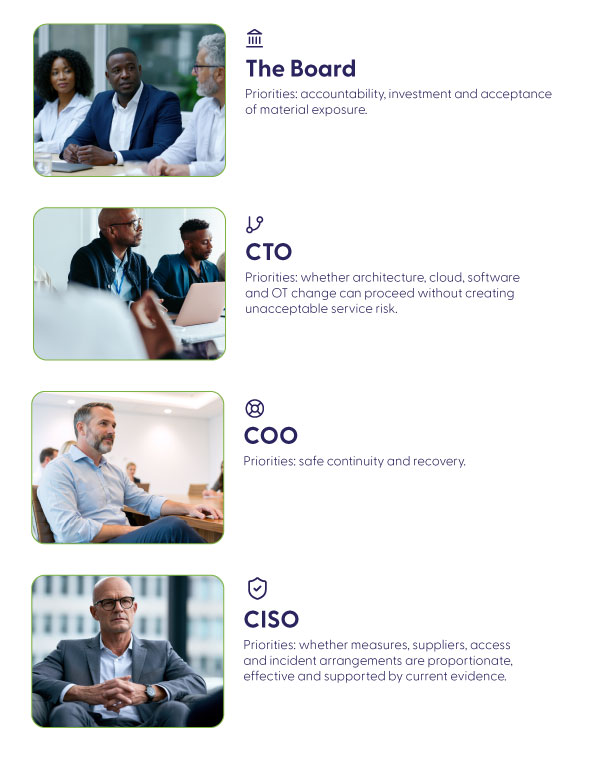
For boards, the issue is accountability, investment and acceptance of material exposure.
For CIOs and CTOs, it is whether architecture, cloud, software and OT change can proceed without creating unacceptable service risk.
For COOs and asset leaders, it is safe continuity and recovery.
For CISOs, it is whether measures, suppliers, access and incident arrangements are proportionate, effective and supported by current evidence.
The organisation may have mature functions and still lack one integrated confidence statement about the service that matters most.
Energy resilience has an unusually short shelf life
Energy organisations are modernising an operating system that cannot simply be paused, rebuilt or recovered on a purely IT timetable.
Essential services may be geographically distributed, safety constrained and expected to remain available continuously. Operational assets can remain in service for decades, while cloud platforms, identity services, customer applications and software releases change weekly or continuously. Specialist suppliers may participate directly in operation, maintenance and recovery.
This produces a collision between different operating speeds: long-lived OT and rapidly changing software; restricted maintenance windows and continuous delivery; local physical assets and shared cloud services; internal operational accountability and external supplier control.
A resilience conclusion reached six months ago may therefore rest on assumptions that are no longer fully valid.
Consider one high-demand scenario
A critical operational platform becomes unavailable during a period of high demand. Control-room teams retain partial visibility, but the identity service required for remote engineering access is degraded. Security teams restrict a supplier account while they investigate suspicious activity. The supplier is slow to establish whether its own platform – or one of its fourth parties – is involved. Operations can continue in a limited mode, but the safe duration of that mode is uncertain.
The incident is not purely cyber, purely operational or purely a supplier issue. Leadership must decide how long the service can remain degraded, whether isolation removes an important recovery option, whether the event may be significant, which stakeholders should be informed and what evidence will demonstrate that the service can be trusted again.
An annual plan may define each responsibility. Only current, exercised evidence shows whether those responsibilities work together.

NIS2 raises the baseline – but the real test is operational
NIS2 makes resilience a management-governance issue. It does not turn the board into a technical control room; it raises the standard of what leadership must be able to understand, approve and challenge.
Article 20 requires the management bodies of essential and important entities to approve cybersecurity risk-management measures and oversee their implementation. Article 21 sets out the risk-management areas that covered entities must address, while Article 23 establishes a staged process for reporting significant incidents.
For energy leaders, this means more than receiving periodic reports on vulnerabilities, tooling or completed activities. Management needs enough visibility to understand which essential services create the greatest consequence if disrupted, which technology and suppliers determine their operation, what level of degraded service is acceptable, which assumptions have been tested and what residual exposure remains.
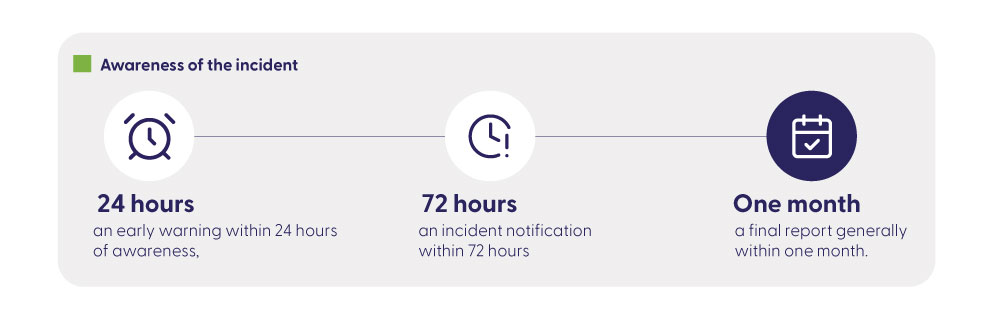
The incident-reporting clock reinforces the same point. A significant incident may require an early warning within 24 hours of awareness, an incident notification within 72 hours and a final report generally within one month. During an incident, leadership cannot begin by discovering who owns the decision, which service is affected or where the evidence lives. That work has to happen before the clock starts. Read our NIS2 for energy leaders paper for more insight in this area.
NIS2 creates the regulatory baseline. The operating challenge goes further. A policy may remain current while a system integration changes. A supplier assessment may remain valid while the supplier changes its subcontractor. A penetration test may remain closed while the application, identity model or exposed service changes. A recovery procedure may remain approved while the production environment moves on.
The leadership objective is not a permanent declaration of resilience. It is the ability to maintain a justified view of resilience as the service changes.
Confidence decays first at the interfaces
The most difficult risks are often not contained within one component. They appear in the relationships between platforms, teams, suppliers and service states.
A cloud platform may be available, but the operational application cannot authenticate. An OT asset may be functioning, but field teams cannot access the information required to intervene safely. A software release may pass functional testing, but behave unexpectedly with a specific supplier configuration. A supplier may restore its service, but the organisation cannot reconcile transactions, operational state or delayed data. A security control may contain a suspected compromise, but remove the access route needed for recovery.
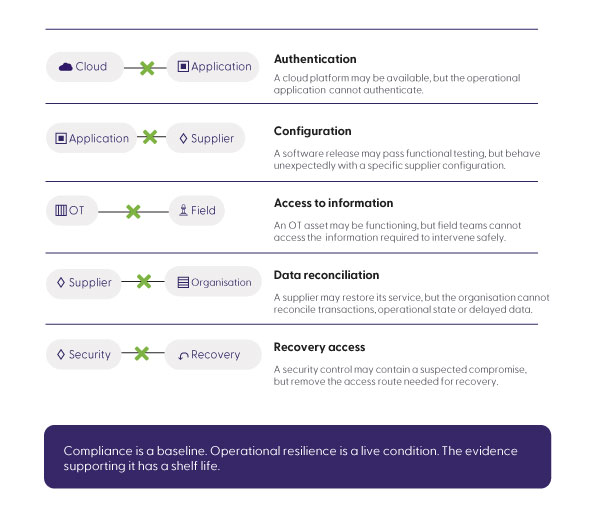
These are interface failures. They are also where fragmented assurance is weakest.
Security assessments, software tests, supplier reviews and continuity exercises are frequently commissioned separately. Each produces useful evidence. But unless that evidence is connected around the essential service, it may not answer the decision leadership actually needs to make.
The assurance boundary should therefore follow the service outcome and its consequence of failure, not the organisation chart or technology ownership model. That means asking whether evidence across software, identity, cloud, communications, suppliers, OT, degraded operation and recovery supports one defensible view of the complete service.
Component assurance can be strong while service confidence remains weak.
Change, suppliers and recovery are where confidence is most often lost
Software change can improve the service and weaken previous evidence
Energy organisation is increasingly depend on software to operate grid and asset platforms, process smart-meter data, manage customer services, support flexibility and connect to market and settlement environments. That software must continue to change. The wrong response is to treat resilience as a reason to slow every programme down. The stronger response is to make evidence move at the pace of change.
Quality Engineering, automation and DevSecOps can make assurance faster and more repeatable, but automation is an enabler rather than the outcome. The strategic value is a more defensible decision about whether change should proceed, proceed within a constrained boundary, be delayed or be redesigned.
Supplier assurance must go beyond questionnaires
Energy services may depend on OEMs, cloud platforms, telecoms providers, software vendors, systems integrators, field contractors and specialist operational-support partners. Certifications, contracts and questionnaires remain useful. They do not necessarily demonstrate whether the organisation’s specific implementation can continue or recover within tolerance.
The stronger question is not whether the supplier completed the process. It is what evidence shows that the supplier will not become the organisation’s outage, information or recovery bottleneck.
Recovery is not complete when the technology comes back
A successful backup does not prove that a service can recover. A restored platform does not prove that data, transactions, asset state and supplier services are consistent. A technically available system may still be operationally untrustworthy. Energy leaders need evidence of safe degraded operation, restoration sequence, access, supplier coordination, data integrity, state reconciliation and operational acceptance.
Does the combined evidence supports the next service decision?
Continuous confidence does not mean continuously testing everything
It means knowing which changes should cause confidence to be reconsidered – and refreshing the evidence before uncertainty becomes live operational exposure.
Annual assurance captures a moment in time. The environment begins changing almost immediately. A material release, supplier transition, architecture change, serious incident, failed recovery exercise or expiring evidence can all alter the conditions on which the previous confidence statement depended.
The model is continuous because the operating environment is continuous – not because every assurance activity runs constantly.
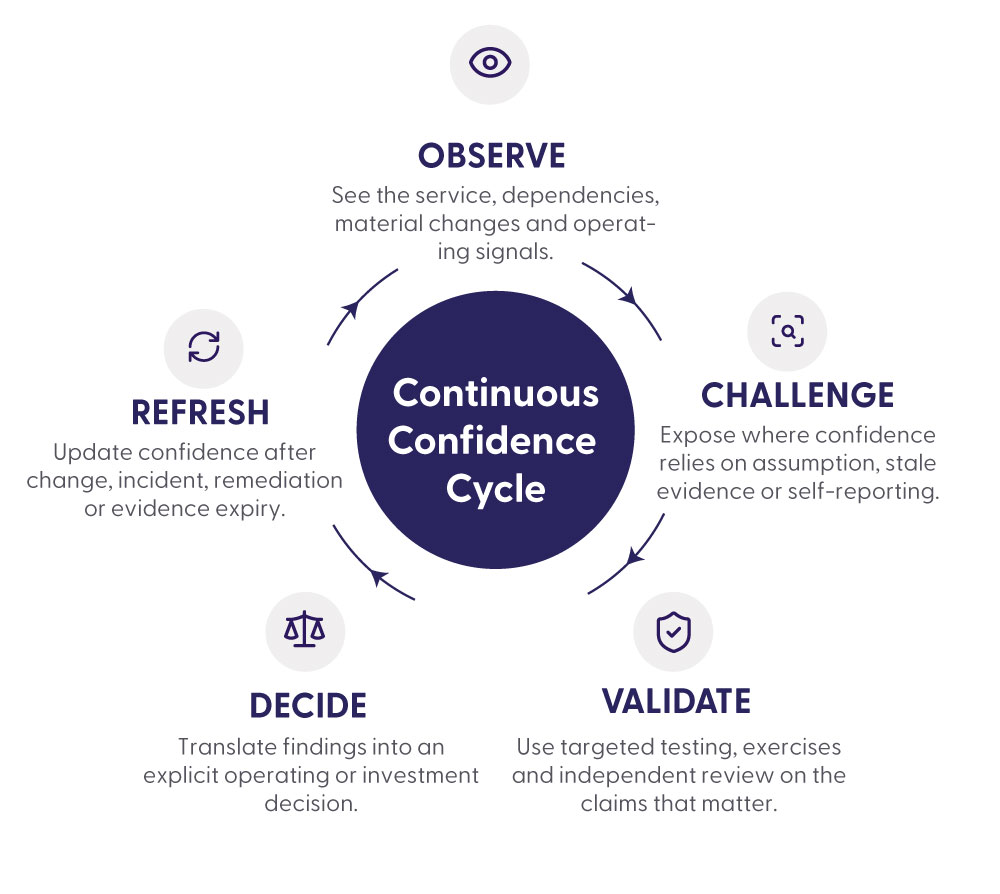
The practical rule is to reassess confidence when the service, its dependencies or the evidence materially changes. A software release may trigger targeted Quality Engineering and security validation. A new supplier may trigger an access, dependency and recovery review. An architecture change may trigger penetration testing or OT assessment. An incident may require assumptions and compensating controls to be revalidated rather than simply documented as closed.
This creates a more useful operating rhythm for strategic leaders. The board does not need a permanent stream of technical detail. It needs a current view of what is proven, what has changed, what remains uncertain, which risks have been accepted and when the evidence will next be refreshed.
Compliance is a baseline. Operational resilience is a live condition. The evidence supporting it has a shelf life.
The question is not only who can help establish confidence today. It’s who can help keep the evidence behind resilience current through the next five years of energy-system change.
The resilience gap opens between audits. Continuous confidence is how energy leaders close it.