
DVB Testing
Get your DVB receiver ready for its target markets
A receiver that works in one market may behave differently in another. Resillion’s Digital Video Broadcasting (DVB) testing helps you check country and operator requirements, investigate reception problems and prepare evidence for the relevant approval process. Find out what needs fixing before you commit to launch.
Trusted by leading organisations
Helping organisations improve quality, resilience and delivery confidence across complex digital estates.


Check the viewing experience, from first installation to everyday use
Can viewers find the right channels during setup? Does the programme guide show the correct information? How does the receiver respond when reception conditions change? These checks help explain whether a television or set-top box is ready for the broadcast services it will receive.
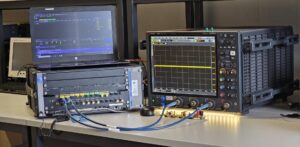
Resillion tests terrestrial (DVB-T/T2), cable (DVB-C) and satellite (DVB-S/S2) receivers. Testing covers the requirements relevant to your product and markets, including free-to-air and subscription services, usability, stability and signal reception. Radio frequency (RF) testing examines how the receiver handles broadcast signals.
Our Evora iSuite provides a web-based framework with more than 2,000 test cases and support for specifications across more than 60 countries and operators. Testers carry out the checks interactively, while reports are generated automatically. Purpose-built test streams help engineers investigate specific requirements and reproduce problems.
We shape the test scope around your receiver, target markets and approval requirements. Where you need wider support, our Total Quality approach brings broadcast testing together with quality engineering, cyber security and content quality services.

BENEFITS
Fewer surprises between development and launch
Give your engineering team clearer priorities and your launch team a better understanding of what is ready.

Know what needs fixing before submission
Identify gaps against the requirements selected for your receiver and target markets.

Plan for differences between markets
Check country and operator specifications rather than assuming one test plan fits every launch.
Investigate reception problems earlier
Examine signal-handling behaviour alongside everyday receiver functions.

Spend less time building test assets
Use an established library of test cases and purpose-built streams.

Keep results easier to review
Automatically generated reports give engineers and reviewers a structured record of testing.

Share testing across teams
Parallel access allows multiple testers to work within the same framework.
WHY US?
What each part of DVB testing tells your team
Each part of the test programme answers a different question, from whether the receiver handles a particular signal to whether the evidence is ready for review.

Evora-supported testing
What this does for you
Our specialists check your receiver using an established test library.
Result
Less time spent creating tests from scratch
Country and operator checks
What this does for you
We test against the requirements for your chosen countries and operators.
Result
Know what needs fixing for each market

Terrestrial, cable and satellite testing
What this does for you
We check how your receiver works with the broadcast types it supports.
Result
Identify problems before submitting your receiver for approval
Signal reception testing
What this does for you
We check how your receiver handles broadcast signals.
Result
Find reception issues while there is still time to fix them

Purpose-built test streams
What this does for you
We recreate specific broadcast conditions to investigate failures.
Result
Give engineers repeatable examples to help diagnose faults

Automatic test reports
What this does for you
We record the checks completed and their results in structured reports.
Result
Easier review of failures and evidence for submission

Testing in parallel
What this does for you
Our testers can carry out checks at the same time.
Result
Less waiting for checks to be completed one after another

Free and subscription TV checks
What this does for you
We check receiver functions for free-to-air and subscription channels.
Result
Identify issues affecting either type of service before release
WHY NOW?
Find launch risks while there’s still time to fix them
Late testing can leave little room to investigate failures, update software and repeat checks. An agreed test plan helps you spot gaps while engineering teams still have time to respond.

A market-specific requirement is missed

Test preparation takes longer than expected

A receiver function fails near submission

Reception behaviour receives too little attention

Engineers cannot reproduce a reported failure

Submission evidence is incomplete
Our experts

Neeraj Kumar P R
A Specialist Cloud Engineer with expertise in designing, deploying, and optimizing scalable, secure cloud solutions in enterprise environments.

Conor Thomson
Expert in Quality Engineering and AI Practices
Conor is a Global Solution Architect with 12 years’ experience in Quality Engineering, QA, test automation, software delivery, AI engineering, and digital transformation.