Fix it while the cameras are still rolling: Why Content QC belongs upstream
A wound that heals overnight. A character who forgets what they said two episodes ago. A coffee cup that appears and disappears between shots (Game of Thrones viewers will remember the takeaway cup at the Winterfell feast, the most surprising arrival in Westeros since the dragons).
Audiences spot these slips, and today they share them within minutes of a release. Yet in most productions, quality control (QC) only gets its first look at the content after picture lock, when the story is already set and every fix is at its most expensive.

Why end-stage QC finds problems too late
Traditional QC checks finished deliverables against technical and platform specifications. It is essential work, but it comes at the very end. By then, a continuity error that began on set has been carried through the edit, the grade, the VFX and every localised version.
The cost of a fix grows at every stage A wrong prop spotted on the day is a quick reset. Spotted at final QC, it can mean a VFX paint-out, a recut or even a reshoot.
Deadlines get squeezed Late findings collide with fixed release and delivery dates, leaving teams to choose between rushed fixes and accepted compromises.
QC becomes a hurdle, not a partner When QC only appears at the end with a list of failures, it is seen as a gate to clear rather than a contributor to the creative work
The audience notices For a premium title, a visible continuity slip can break the “fourth wall” and become the moment everyone talks about.
Continuity issues can be caught earlier
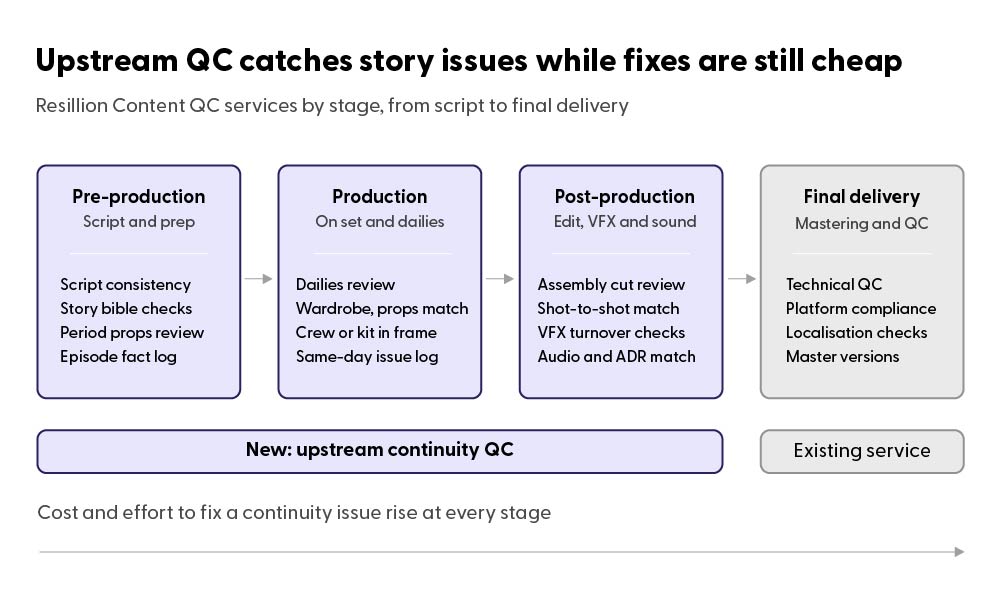
QC specialists spend their days reviewing content frame by frame, trained to spot what others miss. Applied earlier in the process, that same eye protects the story itself. Here are the kinds of issues upstream QC can catch, and where each is cheapest to fix.

Visual continuity
Examples
Props, wardrobe, hair, make-up, set dressing changing between shots
Where it is cheapest to fix
On set / dailies

Physical and timeline logic
Examples
Injuries healing too fast, weather or time of day jumping, character position errors
Where it is cheapest to fix
Dailies / assembly edit

Narrative consistency
Examples
Dialogue contradicting earlier scenes, names, dates or facts that change across episodes
Where it is cheapest to fix
Script / edit

Anachronisms and stray objects
Examples
Modern items in period pieces, crew, equipment or reflections in frame
Where it is cheapest to fix
Dailies / VFX turnover

Audio continuity
Examples
Mismatched ambience, ADR that contradicts picture, dropped lines
Where it is cheapest to fix
Edit / sound mix

Graphics, text and on-screen props
Examples
Signs, screens, documents or captions that change or contain errors
Where it is cheapest to fix
Art department / VFX
Version and localisation drift
Examples
Cuts, subtitles or dubs diverging from the master story
Where it is cheapest to fix
Mastering / localisation
Bringing QC into every stage of production
Upstream QC does not replace final delivery checks. It extends them into the earlier stages, where small corrections prevent big problems later.
Findings from every stage go into one shared issue log, so anything spotted on set or in the edit is tracked through to final delivery. Teams can choose the level of support they need, from remote dailies review to QC specialists working alongside the crew and the edit team.
What production teams gain
Moving QC upstream turns late, expensive surprises into early, routine corrections.

Lower cost of fixes
Issues are solved with a reset, a pickup shot or an editorial choice, not with VFX paint-outs, recuts or reshoots.

Protected schedules
Fewer surprises at final QC mean fewer failed deliveries, fewer platform rejections and less last-minute overtime.

Creative integrity
Directors, editors and showrunners stay in control of the story, rather than accepting compromises forced by a delivery deadline.

Smoother final QC
Content arrives at the final check cleaner, so technical review and platform approval move faster.

One partner from set to screen
A single QC partner across the lifecycle means consistent standards, one issue log and a full audit trail.
Working alongside the creative team
Upstream QC is designed to support the people who already protect continuity, not replace them. Script supervisors and continuity teams gain a systematic, tool-assisted second pair of eyes. Producers and post supervisors gain early warning of issues that could affect budget or schedule. And the creative team gains more time to focus on the story.
Quality that starts with the story
The best time to fix a continuity error is before it reaches the edit. The second best is before it reaches the grade, the VFX or the final master. Content QC that starts upstream gives every production the chance to get there first.
At Resillion, we bring Content QC into production and post-production. We help teams catch continuity issues while they are still quick and cheap to fix and protect the story they set out to tell.
Through our Media Content Advisory and wider Media Content Services, we combine major-studio experience with direct support for production teams.
Explore Resillion’s media content advisory services and plan a smoother route to delivery.