
From exposure to resilience: how leaders can reduce kill-switch risk
Once leaders understand the scale of kill-switch exposure, the next question is straightforward: what do we do about it?
Eliminating the risk is unlikely. The goal is to build resilience so that, if a device behaves unexpectedly, your operations aren’t interrupted.
Traditional testing methods aren’t designed to uncover hidden logic. Penetration testing focuses on attackers and vulnerabilities, not deliberate functionality embedded by the manufacturer. Certification assumes the vendor is trustworthy. Kill-switch resilience demands a broader and more strategic response.
The mindset shift: from reaction to strategic redundancy
Remote access and update channels are valuable for maintenance, but they also create potential shutdown paths. The task is not to remove connectivity altogether but to build systems that remain functional if remote control is lost.
Strategic redundancy means recognising that certificates, compliance marks and normal assurance processes offer limited protection when it comes to kill switches. It means preparing for the possibility that some devices may fail or be disabled through deliberate kill-switch activation by the manufacturer or other adversary, connectivity loss or manufacturer-controlled commands. It means investing in proactive design based on these assumptions to strengthen resilience without limiting functionality.
Practical steps for leaders: your resilience plan
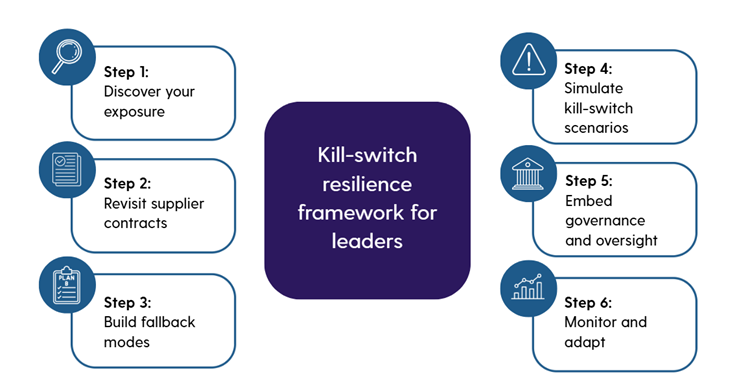

Discover your exposure
Map your devices, firmware versions, update pathways and connectivity dependencies. Identify who controls each subsystem and under what conditions failure could occur. This should include identifying scenarios in which a device ceases to operate when connectivity to a manufacturer-controlled server is blocked.

Revisit supplier contracts
Ensure procurement agreements require transparency around remote-management capabilities. Introduce audit rights where feasible and negotiate local-only operation for critical equipment. If manufacturers retain privileged accounts, hardcoded credentials or over-the-air (OTA) update authority, build contractual mechanisms that allow you to test or revoke these paths.

Build fallback modes
Develop manual overrides, local control channels and safe-mode firmware. Design systems so that one compromised component does not disable the rest. Make sure the fallback design extends to full operational scenarios.

Simulate kill-switch scenarios
Test how devices behave when connectivity fails, updates corrupt or remote commands stop working. Simulations should explore manufacturer-trigger conditions such as tamper detection, repeated failed telemetry uploads or anomalous heartbeat loss – even a seemingly benign drop in telemetry can trigger a shutdown mechanism. Then, validate recovery steps and data-capture processes.

Embed governance and oversight
Elevate kill-switch resilience to the board. Form cross-functional teams that include operations, cyber, engineering, legal and procurement.

Monitor and adapt
Track anomalous device behaviour, firmware changes and unexpected network communication. Review resilience plans regularly and update them as systems evolve.
Why redundancy beats switching off remote access
Some organisations consider removing remote access entirely. In practice, this is rarely sustainable. Remote channels support patching, diagnostics and regulatory compliance. Disabling them can create blind spots and increase long-term risk. Additionally, some kill-switch mechanisms exist at hardware level and cannot be neutralised simply by blocking a network connection. A resilience-led approach is more effective because it recognises that device ecosystems must be managed, not simply restricted.
Real-world insight: how Resillion supports resilience
Resillion helps organisations operationalise kill-switch resilience by combining technical analysis, scenario design and governance support. Using a structured assessment method, our teams assess devices for hidden logic, simulate activation paths and perform black-box tests, reverse engineering, behaviour analysis and vulnerability discovery. Then, we help create fallback modes that keep operations running. Our experience includes cases where suspicious network behaviour in municipal camera systems was identified without requiring full reverse engineering, enabling quicker, more informed decisions.
Strengthening resilience for the long term
Kill-switch capability is a strategic risk, not a niche technical concern. By building redundancy, strengthening supplier assurance and simulating real-world scenarios, leaders can stay ahead of the issue and maintain confidence in their operations. The goal is not to eliminate risk entirely but to ensure that critical services remain in your control, even when devices do not behave as expected.
In an environment where modern fleets, sensors, cameras, solar infrastructure and operational technology increasingly depend on remote connectivity, resilience is now a board-level responsibility.
How Resillion can help
Resillion helps organisations turn kill-switch awareness into practical resilience. Our specialists combine device-level analysis with operational planning to help you understand where hidden control paths may exist and how they could affect critical services.
We design fallback modes, validate update and access channels and work with your teams to strengthen governance and continuity procedures.
With concrete evidence and a clear resilience plan, you can make informed decisions, manage supplier risk and keep essential operations running with confidence.